
How to fight the problem of production employee turnover with robotization
Modern industrial plants face a challenge that generates enormous costs and problems: high employee turnover. In order to effectively manage this phenomenon, companies are increasingly using robotization, treating it not as a tool for reducing jobs, but as an opportunity to create an attractive, dynamic work environment and a strategic investment in workforce development and, in fact, the creation of new positions.

Demographic challenges of the labor market
The source of the current acceleration of turnover is deep social and technological changes that shape the expectations of young generations entering the labor market. Young employees are not only waiting for change, but even declare that they need guarantees of variability in duties, environment, and the nature of work. For representatives of younger generations, having several different entries in a CV, indicating various professional experiences, has become a “must have”.
This need for variability is intensified by technology, especially mobile solutions, which have been present with people currently entering the labor market practically since early childhood. They constantly deliver new stimuli, make it difficult to maintain attention, which leads to the rapid appearance of boredom and the desire for change.
Companies, especially those that produce the same products even for 20 years, in a process that consists of a series of repetitive and rather monotonous activities, are now increasingly facing the challenge of how to provide employees with the expected variability.
The problem does not lie solely in ensuring employee well-being, but more importantly from the point of view of running a production business, in maintaining their high efficiency. It turns out that turnover forced by the market and the need for change observed among employees leads to a drastic decline in the quality of work. People who frequently change their roles do not have enough time to fully onboard, engage, and thoroughly learn their area of responsibility, and they are already moving on to the next task. Additionally, in the Polish demographic reality, where the number of people willing to work – especially among representatives of younger generations – is steadily decreasing, companies must look for alternatives and use human potential more efficiently.
Robotization and the need to manage change
In the face of growing employee turnover, robotization is becoming a strategic way to manage the workforce of manufacturing companies. And it is not about getting rid of employees and replacing them with robots, because these still require operation. It is rather about building such a production architecture that investment in robots goes hand in hand with investment in people. Companies must and increasingly pay attention to the need to prepare workplaces and the organizational structure in such a way as to respond to demographic changes appearing in current and future generations.
As a result, more and more often, when a machine takes over repetitive, manual activities, existing production employees are encouraged or persuaded to change their professional profile and acquire new knowledge and skills, which provides them with the desired variability and prospects for development.
In this context, robotization opens two main career development paths for employees:
-
Engineering path (hard skills): implementation, operation, servicing, or inventing new applications for machines, which requires learning new, hard competencies.
-
Soft/business path: including managerial positions (e.g., project manager) or focusing on continuous process improvement. People are necessary to create better ideas and optimization. In many contexts, orientation toward external stimuli allows people to react faster and see certain things better than machines.
For production managers, managing change simultaneously in the technological and human dimension therefore becomes the main task. It requires creating a plan that will allow, after robotization, not to reduce employment but rather to develop teams within the company and expand their field of activity.

Source: HumanImpact™ Report
The HumanImpact 2025 report shows that thanks to this dynamic, the reduction in employment resulting from automation is not as large as one might think based on some media reports (see the figure above).
The key role of education in fighting employee turnover
For employees to actually coexist with robots in a production environment with the greatest benefit for the entire organization, a key component of change must appear: education. Companies that approach workforce development strategically achieve measurable benefits. Many organizations are already beginning to notice this.
One company from the electronics industry in southern Poland noticed that employees stay in one position on average for two years, but after changing their function they need a year to reach full productivity. This means that for half of their time working in the company, their productivity is far below their capabilities. For the company, this means real financial losses.
The high costs generated by turnover therefore prompted the management of the aforementioned company to compare expenses. It turned out that if the funds that the organization was losing due to turnover were allocated to training for employees, turnover would decrease and revenues and profits would most likely increase. The company followed this path and organized something resembling an internal school for employees.
Other entrepreneurs are reaching similar conclusions. More and more companies are building their own internal education centers whose task is to share knowledge with new employees and give people space for independent development. Such activities make it possible to reach people who want to develop, who are ready to invest their time in learning new skills and who see a space for development within the company. Providing freedom and tools for development results in employees, for example process engineers, coming forward themselves with well-thought-out optimizations.
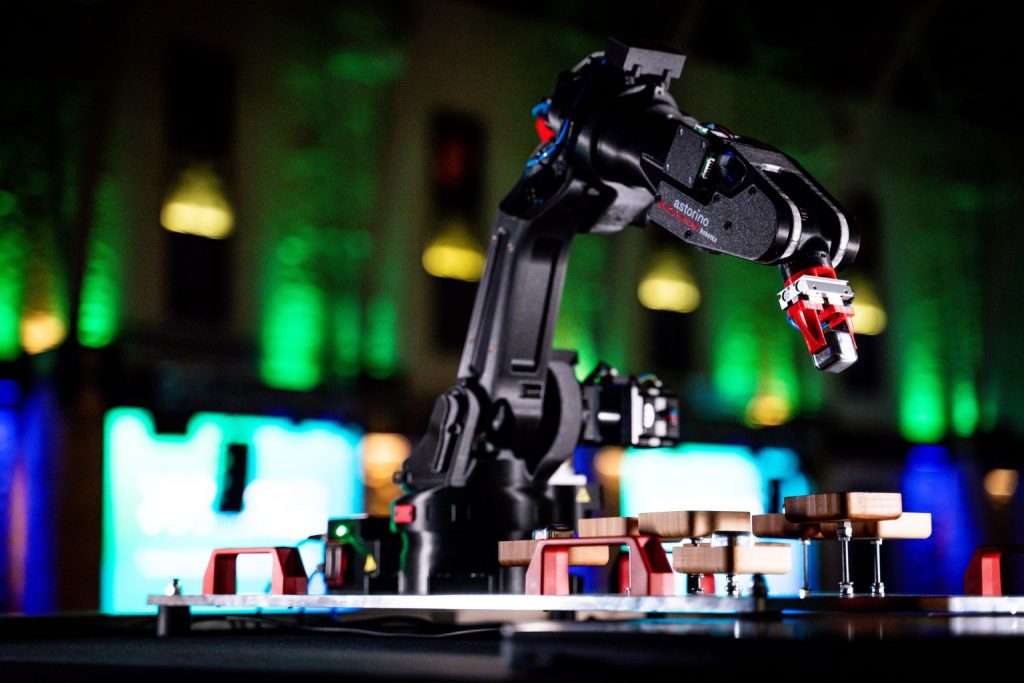
Astorino educational robot
Selected companies also invest in education outside their own plants. By providing training devices (such as, for example, Astorino educational robots) to educational institutions cooperating with them, they ensure that people entering the labor market already know robotics, which is treated as an investment in the future of the market.
Examples of companies and actions taken
-
A company operating in the plastics processing industry had a problem obtaining independent employees for production lines. The management wanted to employ people who want to do more than just deal with simple packaging. Recruitment offers were directed to those who want to go “to work”, not “to toil”. In order to obtain such employees, the company began to take care of schools in its surroundings, encouraging them to become more engaged. It began hiring graduates of technical schools on employment contracts, offering support in undertaking studies (for example in robotics).
-
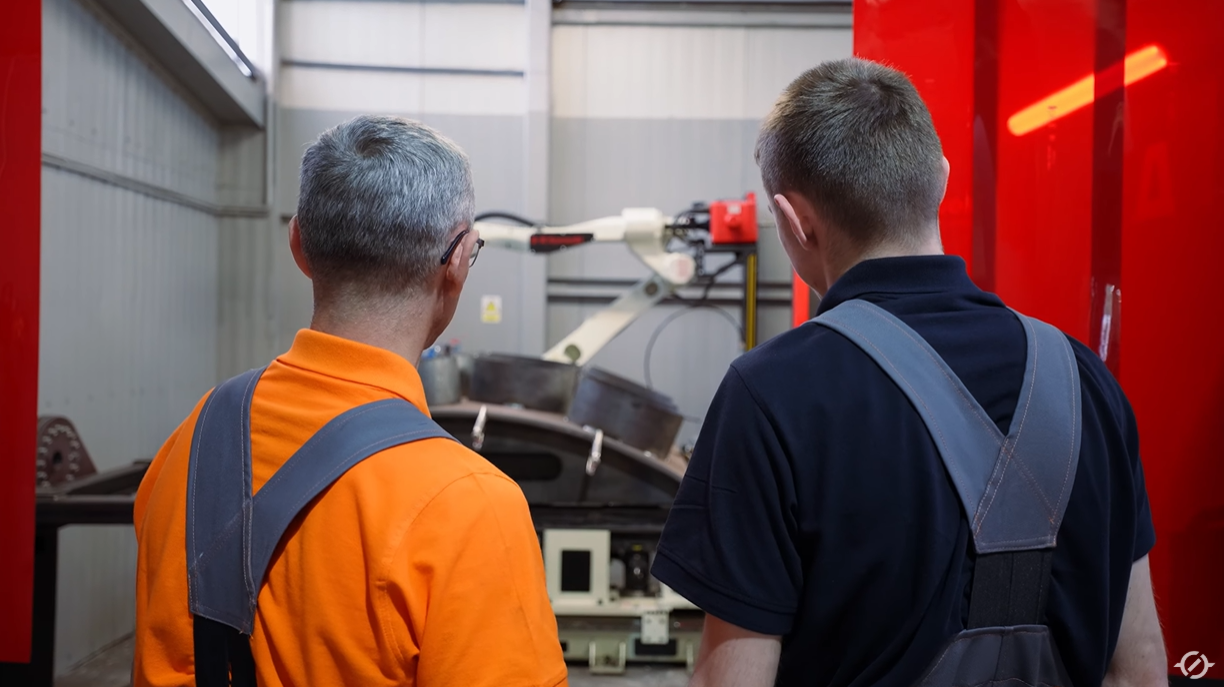
In a company producing metal products, initial fears of robots were overcome thanks to a grassroots initiative by the welding shop foreman, who found a robotic solution tailored to specific needs. The implementation did not lead to job reductions; on the contrary, a need arose to employ a worker to operate and develop the robots. The installation made it possible to increase production efficiency and at the same time accelerated the development of employees toward robot programming and tooling preparation. Employees performing repetitive welding work were moved to more profitable orders, thanks to which they can develop their skills. Importantly, after the first implementation the team itself began to come forward with proposals for further improvements and applications of robotization.
-
The Polish branch of a global technology company operating in northern Poland is actively building its own education centers, sharing knowledge with new employees and giving them space for development.
Summary
Robotization does not consist solely of implementing technological solutions that automate the production process. It is also a new approach to managing human capital. In manufacturing companies, robots become a tool supporting development, which makes it possible to redirect employees to tasks with higher added value and provides the space for continuous change expected by younger generations. In order to invest in robots, companies must understand where these machines will have a chance to truly help and, as a result, earn their keep. Therefore, they need people who will see where the greatest value from the investment lies and what needs robotization should respond to. If, in the process of automation, companies focus on people, robotization will be much less invasive, employees will be more engaged, and the companies themselves will be far more efficient both in processes and in business.