
“Robotics from Scratch with Astorino.” The first robotics textbook in Poland for technical secondary schools
A free publication titled “Robotics from Scratch with Astorino. Volume I. Fundamentals of Robotics” has been released. It is the first robotics and robot programming textbook in Poland designed specifically for technical secondary schools. The book has been developed to support teachers in their daily work and to help students enter the world of robotics through hands-on practice, clear explanations, and work with a real educational tool. It is a natural extension of the educational ecosystem built around the Astorino robot over the years.
The author and his educational mission
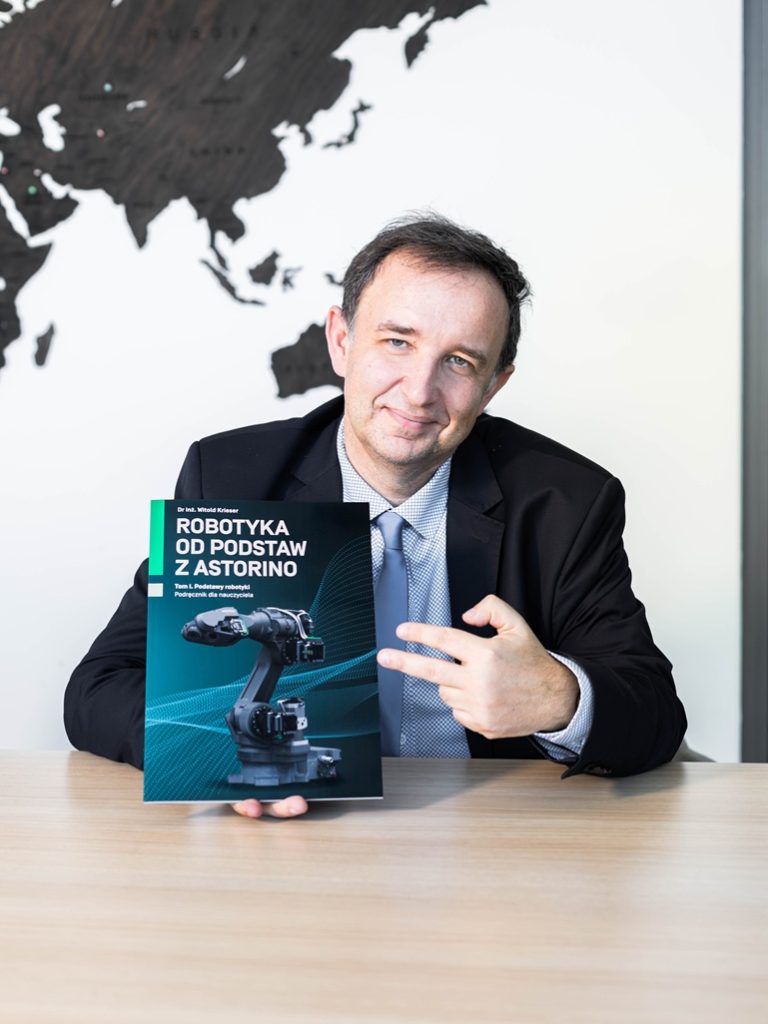
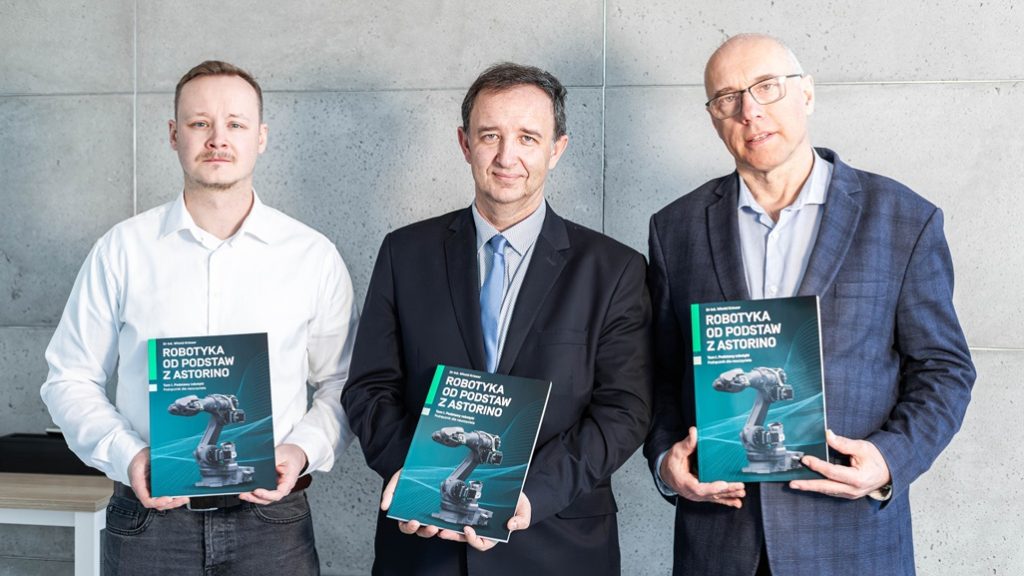
The author of the textbook is Dr. Eng. Witold Krieser – a PhD in technical sciences, lecturer, and teacher. He is an educator who has long combined school, academic, and practical experience, as well as a promoter of engineering sciences who consistently fosters interest in robotics, automation, and mechatronics among children and young people.
“This first volume covers the fundamentals of robotics – to understand how a robot is built, but also to perform the first movements and write the first programs, without the need for advanced mathematics at this initial stage of working with a robot,”
emphasizes Witold Krieser. He adds:
“When students realize that they can start a robot on their own and make the first movement, a breakthrough moment occurs – they want more.”
Learning based on real industrial technology
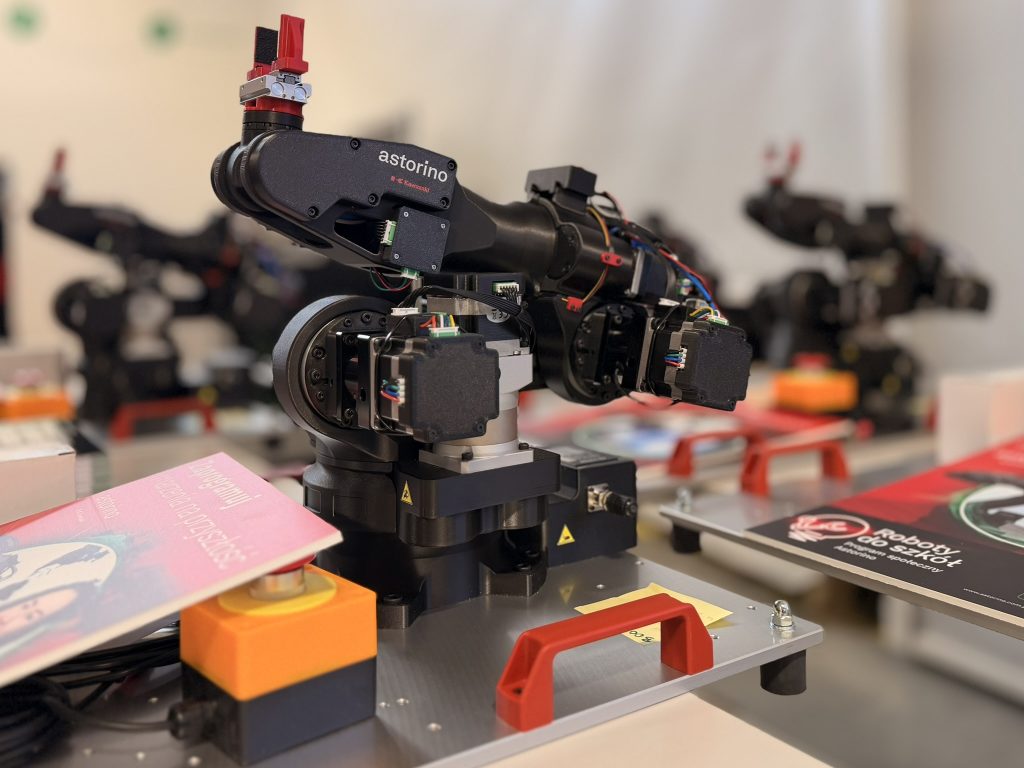
The publication is based on the Astorino robot—an educational robot with an industrial character, programmed in the same way as Kawasaki Robotics robots used in industry. This is one of the textbook’s strongest advantages: students do not work on an abstract model, but on a solution that reflects the industrial environment and the way robotics is approached in factories. ASTOR emphasizes that Astorino was designed as an educational robot that teaches skills genuinely useful in future careers.
“A program written for Astorino can later be transferred to an industrial robot. This makes a huge impression and shows students that they are learning something that can help them land their dream job in the future,”
says Witold Krieser.
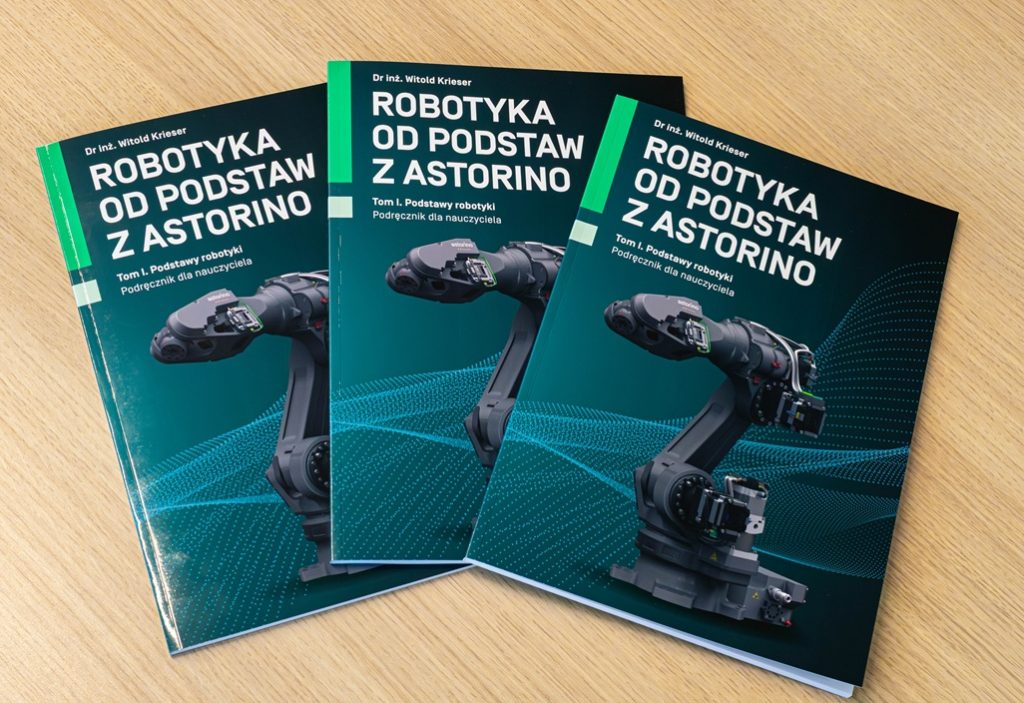
The textbook can be downloaded free of charge via a form on the website:
https://astorino.com.pl/podrecznik-nauczania-robotyki/
A working tool for teachers and students
An important distinguishing feature of the textbook is its practical didactic structure. “Robotics from Scratch with Astorino” has been prepared in both a teacher’s version and a student’s version. Each chapter includes a set of theoretical topics, exercises, and knowledge tests. The material is aligned with the core curriculum for the robotics technician profession and supports preparation for vocational exams, especially in the theoretical part.
The textbook therefore serves several functions simultaneously: it introduces robotics topics, systematizes knowledge, and enables its verification and consolidation. As a result, it is not just a popular science publication, but a practical teaching tool for schools.
“This is a textbook designed to guide students step by step—from the basics to their first real applications of robotics. The goal was to make it user-friendly—for both students and teachers. It was meant to inspire further learning and exploration of robotics, not to be a barrier. This first volume covers the fundamentals of robotics—to understand how a robot is built, but also to perform the first movements and write the first programs, without requiring advanced mathematics,”
emphasizes Witold Krieser.
Education as a strategic investment
Stefan Życzkowski, founder and co-owner of ASTOR, shares the observation that:
“For years, robotics was a very specific and niche field. We wanted to take the next step—to make it more widespread, more accessible, and more understandable. Especially since Europe now has a significant gap to close in robotics. One of the biggest barriers is the lack of practical knowledge.”
The new publication is part of ASTOR’s broader mission, with education of future engineers and strengthening respect for Polish engineering thought—both domestically and internationally—as one of its pillars. In this sense, the textbook does not function in isolation—it is part of a larger process in which schools receive not only equipment, but also methodology, lesson scenarios, and concrete teaching support. Today, Astorino is already used in around 200 schools, and 20 robots have been provided under the “Robots for Schools” program. During the March ASTOR event, the textbook premiere was presented as a complement to this educational model.
Polish technology that inspires pride
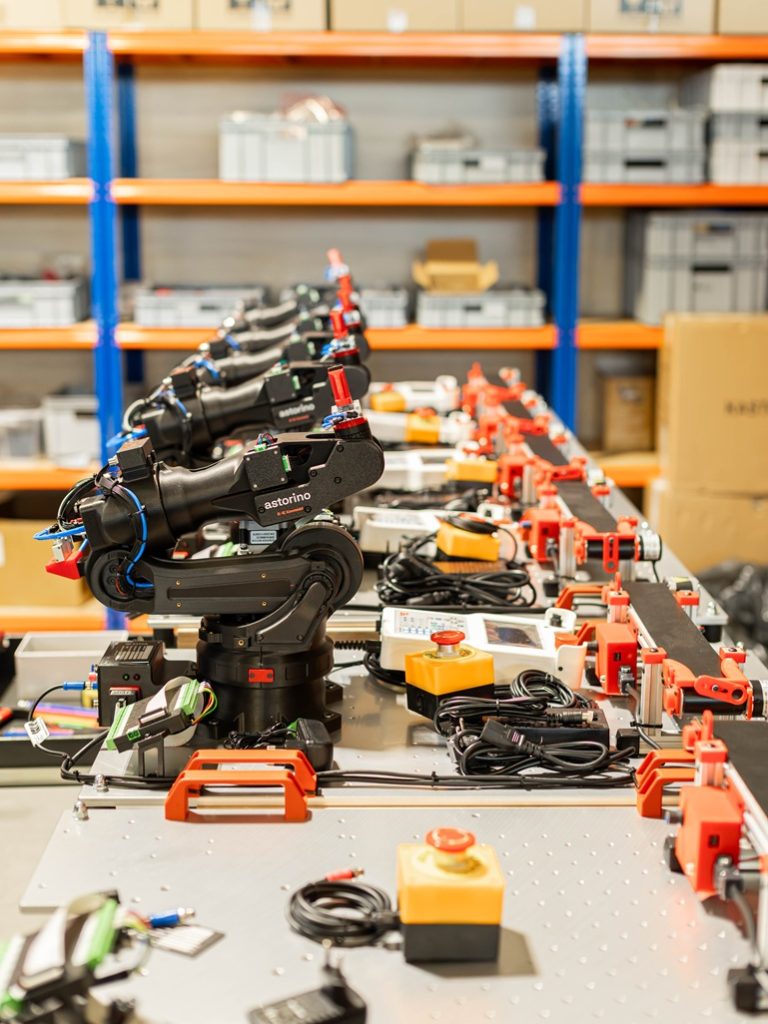
Astorino itself is a unique project, also as a source of pride for the Polish technology sector. The robot was designed and developed by Marek Niewiadomski, chief designer at ASTOR, inventor, and creator of Astorino. It is manufactured in Poland, at the ASTOR Robotics Center in Kraków, and 99% of its structure is produced using 3D printing technology. Marek Niewiadomski is responsible for creating a solution that combines educational accessibility with the industrial DNA of a robot.
A global dimension: from Poland to Japan
Today, the significance of Astorino goes beyond Poland. The robot has been part of ASTOR’s offering since 2021, and since 2022 it has also been distributed by Kawasaki Robotics in Europe, with further international expansion to countries including Japan and the United States.
The year 2025 was particularly symbolic. ASTOR became a partner of the Polish Pavilion at Expo 2025 Osaka, Kansai, and during the “Days of Polish Science and Education,” demonstrations of Astorino robots were announced in front of the Pavilion. Another important milestone was the September signing of an agreement between ASTOR and Kawasaki during the Polish–Japanese Investment Forum in Osaka. The culmination of 2025 was Astorino’s presence at iREX 2025 in Tokyo, where a new version of the robot—Astorino C—was presented, designed specifically for the Japanese market.
The future of industry starts in the classroom
This is why the release of “Robotics from Scratch with Astorino” is more than just a new publication. It is another step toward building modern technical education in Poland—one that connects schools with industry, theory with practice, and Polish engineering creativity with international ambition.
“Practical skills—that’s what is most needed today, and there is still too little of them,”
concludes Stefan Życzkowski. At the same time, it shows that “Made in Poland” in robotics can mean not only a good idea, but also a solution that reaches schools, global trade fairs, and the international conversation about the future of technological education.
The textbook can be downloaded free of charge via a form on the website:
https://astorino.com.pl/podrecznik-nauczania-robotyki/